


 Deutsch
 English
 Español
 Français
 Nederlands
 Português


 Share
Share




China's escalating export controls on rare earths and critical minerals, tightened from October 2025 through early 2026, have triggered sixfold price spikes outside China and driven European licensing approval rates below 25%, exposing a severe Western dependency. Beijing controls approximately 90% of global rare earth processing and 94% of permanent magnet production, according to the International Energy Agency's 2026 report. In response, the United States launched the Forum on Resource Geostrategic Engagement (FORGE) in February 2026 and Project Vault—a $12 billion strategic reserve initiative—while signing 21 bilateral critical minerals deals and mobilizing over $30 billion in financing. This article analyzes whether the West's scramble to build independent processing capacity can succeed within a narrowing 12-18 month window, or if China's structural advantages will entrench its dominance for decades.
China's Strategic Leverage: Export Controls as a Geopolitical Weapon
China's rare earth export controls, first announced in October 2025 under Ministry of Commerce Notice 2025 No. 61, require exporters to obtain licenses for shipping rare earth products abroad, with authorities evaluating each application based on national security and foreign policy considerations. The regulations expanded to cover dual-use items containing even trace amounts of Chinese-origin rare earths, effectively extending Beijing's reach to goods manufactured outside China. By early 2026, licensing approval rates for European firms had fallen below 25%, while prices for neodymium-praseodymium oxide surged from approximately $80 per kilogram in 2024 to over $480 per kilogram in early 2026—a sixfold increase.
Rather than imposing outright bans, China employs temporary and reversible restrictions to maintain pricing power and extract strategic concessions. A notable example occurred in November 2025, when Beijing suspended planned export bans in exchange for U.S. tariff reductions. This approach, described by analysts as "weaponizing control rather than scarcity," allows China to discourage large-scale Western alternative investment while keeping its options open. The critical minerals supply chain remains tightly integrated with Chinese processing infrastructure, making diversification exceptionally difficult.
The Western Response: FORGE, Project Vault, and Bilateral Deals
FORGE: A New Multilateral Framework
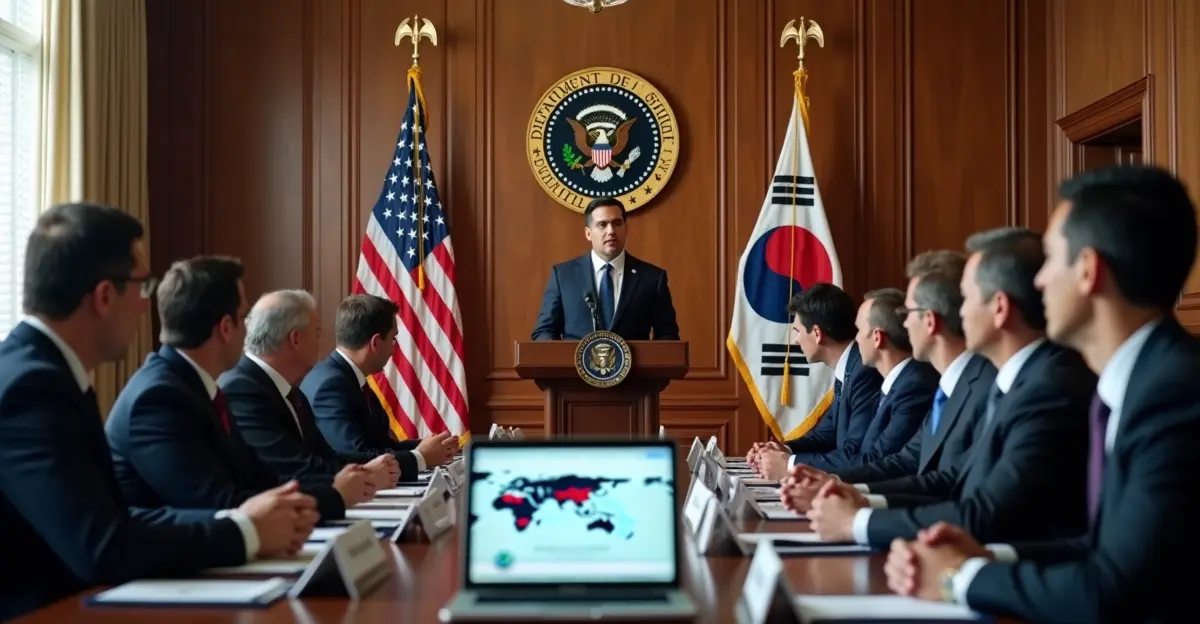
On February 4, 2026, U.S. Secretary of State Marco Rubio, alongside Vice President JD Vance and other top officials, hosted the 2026 Critical Minerals Ministerial with representatives from 54 countries and the European Commission. The centerpiece was the launch of FORGE (Forum on Resource Geostrategic Engagement), which succeeds the Minerals Security Partnership (MSP) and is initially chaired by the Republic of Korea. FORGE aims to create a preferential trade-and-investment zone with coordinated price floors to counter adversarial market manipulation. Vice President Vance described reference prices maintained through adjustable tariffs to uphold pricing integrity. The initiative seeks to link bilateral deals into a plurilateral system covering two-thirds of the global economy.
Project Vault: A $12 Billion Strategic Reserve
The Export-Import Bank of the United States (EXIM) announced Project Vault, a $12 billion decentralized public-private initiative to strengthen America's critical mineral supply chains. Backed by a $10 billion EXIM loan and nearly $2 billion in private investment, Project Vault establishes the U.S. Strategic Critical Minerals Reserve, storing essential raw materials in secure facilities across the country. Unlike the National Defense Stockpile, which is designed for defense purposes, Project Vault is OEM-driven and demand-led—manufacturers identify needed materials and commit financially. The reserve functions as a long-term insurance policy, with manufacturers paying commitment fees and covering storage and interest costs. Minerals will initially be sourced globally, including potentially from China, to build inventory efficiently.
Bilateral Frameworks and Financing
The U.S. has signed 11 new bilateral critical minerals frameworks or MOUs with countries including Argentina, Morocco, the Philippines, and the UAE, bringing the total to 21 bilateral deals in five months. The administration is mobilizing over $30 billion in U.S. government support for strategic minerals projects, including EXIM financing, development finance, and private-sector partnerships such as the Pax Silica initiative and a Glencore MOU for DRC copper and cobalt assets. The FORGE critical minerals initiative represents a significant shift from an exclusively America First domestic focus toward international collaboration, recognizing that insulating supply chains requires coordinated action across partners.
Can the West Catch Up? The 12-18 Month Window
Despite these ambitious efforts, experts warn of a narrowing 12-18 month window for Western nations to build independent processing capacity before Chinese dominance becomes structurally entrenched. The IEA's 2026 report reveals that by 2035, non-China projects would cover only 50% of mining, 25% of refining, and under 20% of magnet demand. Rebuilding independent supply chains could take 20 to 30 years, far exceeding the current geopolitical window. The core challenge is not mining but processing—tacit industrial knowledge in separation, metallization, and magnet-making cannot be quickly replicated through capital investment alone.
China's dominance extends beyond rare earths: Beijing controls roughly 80% of tungsten processing and 60% of antimony, while also tightening export controls on gallium and germanium. Over 80% of European firms depend on Chinese supply chains for materials essential to defense, electric vehicles, and renewable energy. The Western critical minerals dependency on China creates vulnerabilities that extend across multiple high-tech and defense sectors.
Systemic Risks and Economic Implications
The International Monetary Fund has warned that critical minerals fragmentation poses systemic risks to global growth. A modeled scenario where markets split into two trading blocs found that global net investment in renewable technology and EV production would be about 30% lower. The IMF calls for multilateral cooperation, including enhanced WTO rules on export restrictions, data sharing, and establishing an institution focused solely on critical minerals, similar to the International Energy Agency.
The impact on key industries is already visible. Defense contractors face supply constraints for permanent magnets used in precision-guided munitions and radar systems. EV manufacturers confront rising costs for neodymium magnets essential to electric motors. Wind turbine producers struggle to secure dysprosium and terbium for high-performance turbines. The rare earth magnet supply chain remains a critical bottleneck for the global energy transition.
Expert Perspectives
"China's export controls are not about scarcity—they are about leverage," said Dr. Rebecca Chen, a senior fellow at the Center for Strategic and International Studies. "By keeping restrictions temporary and reversible, Beijing maintains maximum flexibility while discouraging long-term Western investment in alternative processing capacity."
"The 12-18 month window is real, but it's not about building full-scale processing plants," noted James Mitchell, a supply chain analyst at the Atlantic Council. "It's about making enough progress to demonstrate viability and attract private capital. If we don't show tangible results by late 2027, the window closes."
"Project Vault and FORGE are important steps, but they address symptoms, not the root cause," said Professor Li Wei of Tsinghua University. "China's advantage in rare earth processing is built on decades of infrastructure investment, skilled labor, and integrated supply chains. That cannot be replicated in a few years."
Frequently Asked Questions
What are rare earth elements and why are they important?
Rare earth elements are a set of 17 metals essential for high-tech applications including electric vehicle motors, wind turbines, defense systems, and consumer electronics. Despite their name, they are relatively abundant in the Earth's crust but difficult to extract and process economically.
How much control does China have over rare earth processing?
China controls approximately 90% of global rare earth processing and 94% of permanent magnet production, according to the International Energy Agency. This dominance extends to other critical minerals, with China controlling 80% of tungsten and 60% of antimony processing.
What is FORGE?
The Forum on Resource Geostrategic Engagement (FORGE) is a U.S.-led multilateral initiative launched in February 2026 that succeeds the Minerals Security Partnership. It aims to create a preferential trade-and-investment zone for critical minerals with coordinated price floors, initially involving 54 countries and chaired by South Korea.
What is Project Vault?
Project Vault is a $12 billion public-private initiative backed by the U.S. Export-Import Bank to establish a Strategic Critical Minerals Reserve. It stores 60 critical minerals for civilian industries, with manufacturers identifying needed materials and committing financially to the reserve.
Can the West reduce its dependence on China for critical minerals?
Experts are divided. While the U.S. and allies have launched ambitious initiatives, rebuilding independent processing capacity could take 20-30 years. The IEA warns that by 2035, non-China projects would cover only 25% of refining needs. The next 12-18 months are considered critical for demonstrating progress.
Conclusion: A Race Against Time
The critical minerals landscape has become the defining geoeconomic flashpoint of 2026. China's structural advantages in processing and supply chain integration are deeply entrenched, built over decades of strategic investment. The Western response—FORGE, Project Vault, and a web of bilateral deals—represents an unprecedented mobilization of resources and diplomatic capital. However, the gap between ambition and execution remains wide. The next 12-18 months will determine whether the West can build enough independent capacity to break China's stranglehold, or whether critical minerals will remain a source of strategic vulnerability for decades to come.


Follow Discussion